 sales@customrigidboxes.com
 (631) 250-5009


What Is Grey Board and Why Is It Used in Packaging?
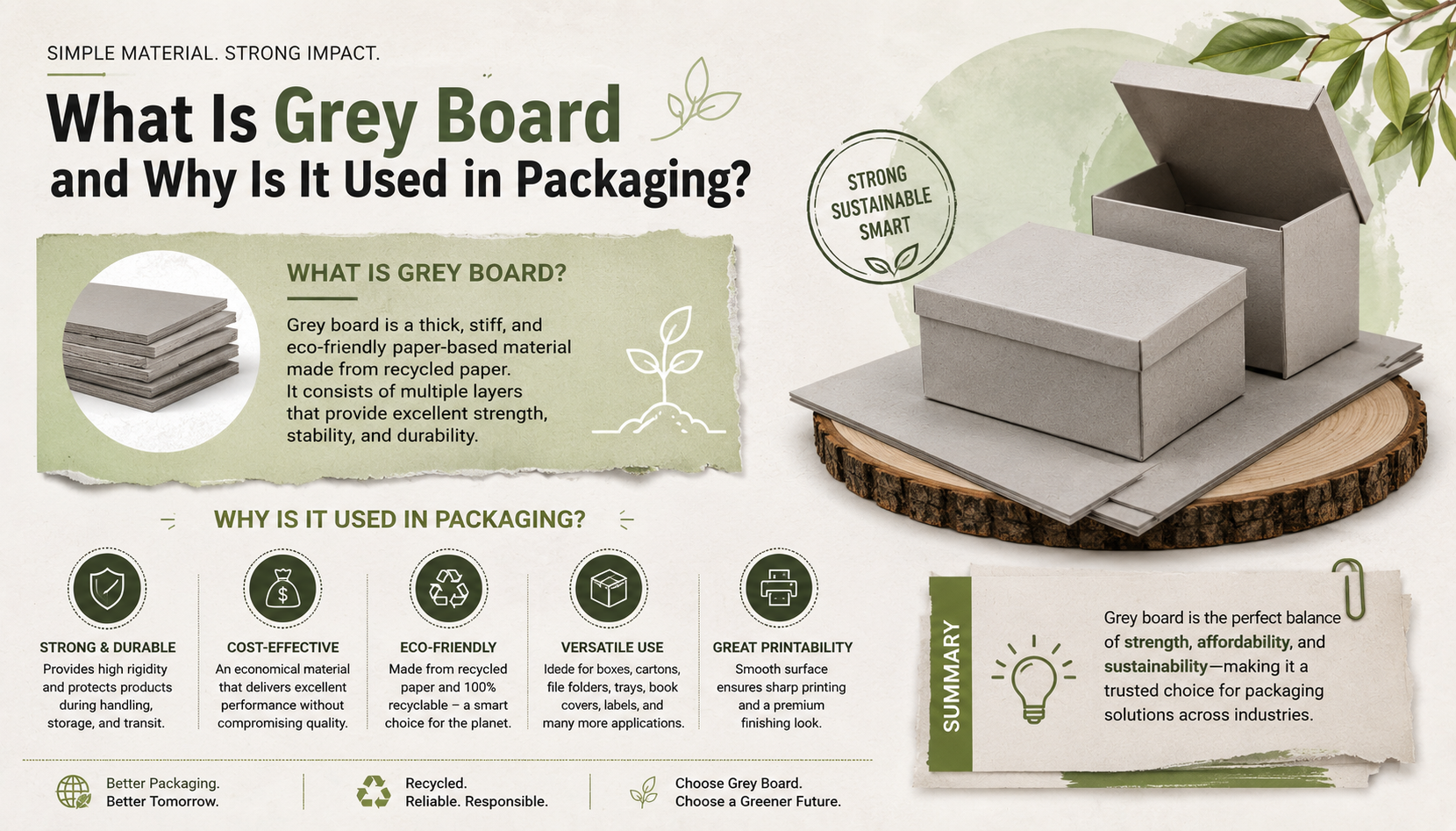
As far as premium packaging is concerned, the choice of material is important in offering protection to the products, improving brand perception, and creating an unboxing experience. A packaging material that has gained popularity among many companies in the packaging industry is grey board. Grey board packaging is very popular because of its high strength, durability, and eco-friendliness. This material can be used in premium retail boxes, gift boxes, cosmetics, electronics, and other rigid boxes.
What is grey board and why do many brands use it in their premium packaging?
This article will cover all the important aspects of grey board, such as how it is made, its types, features, and reasons for being a popular packaging material.
What Is Grey Board?
Grey Board, also known as grey chipboard, paperboard, and rigid board, is an extremely dense paper-based board made using recycled paper fibers. While the corrugated board features fluting in the middle layer, the grey board is made by combining several layers of recycled pulp to form a solid and rigid board.
The natural color of the grey board is grey because it is made of recycled paper. Even though the core of the board is still grey, the outside of the box can be wrapped using printed paper, kraft paper, textured paper, fabric, or even some other special material to make eye-catching custom rigid boxes.
Because of its compressive strength, grey board is ideal for packaging delicate products.
Why Is Grey Board So Popular in Packaging?
Consumers today require packaging that not only offers product protection but also showcases the brand quality and details. Grey board packaging meets both criteria.
It has sturdiness, which ensures the safe transportation of the products and gives a luxurious look to the package. From jewelry to perfumes, from smartphones to chocolates, whatever product you are packaging, grey board offers strong foundations that communicate quality even before the consumer handles the package.
Moreover, as sustainable packaging solutions have become a necessity in the current business scenario, greyboard is used by manufacturers due to its recyclable aspect.
How Is Grey Board Made?
Knowledge of the manufacturing process will help us understand why grey board is much stronger than regular paperboard.
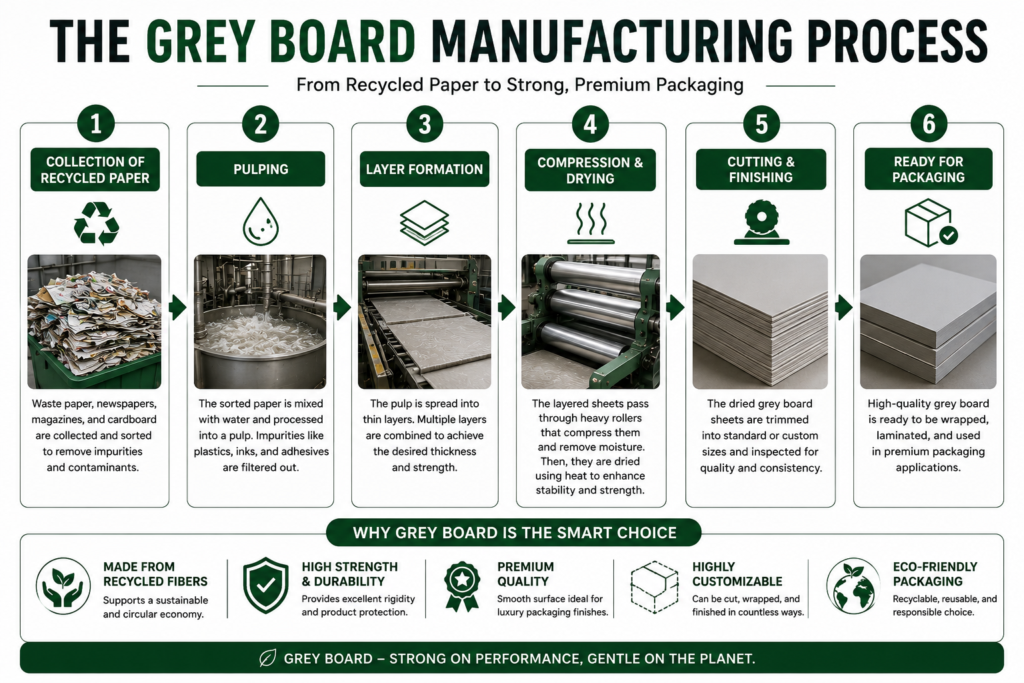
1. Collection of Recycled Paper
The first step in the manufacturing process entails collecting waste paper, newspapers, magazines, office papers, and cardboard. The collected papers are then sorted and cleaned to be ready for the production process.
Recycled fiber content makes grey board one of the most environmentally friendly packaging materials.
2. Pulping
Pulping involves soaking the sorted paper with water and grinding the mixture into pulp form. In this process, all unnecessary items like plastics, metals, and adhesives are separated.
3. Layer Formation
Unlike regular paper, the pulp is made up of several layers that are pressed together using specific pressure. It is due to this reason that the grey board gets its thickness and density.
Different layers can be used to attain different thicknesses and weights of boards.
4. Compression and Drying
Pulp sheets go through heavy-duty rolls that squeeze out the water from them and make them compact. Sheets are dried with the help of high-temperature drying equipment.
5. Cutting and Finishing
After being dried, these sheets are cut into the required sizes and can even be treated based on their applications, like lamination or covering with a printed sheet of paper.
It produces smooth and compact sheets that form the core of many packaging options.
Types of Grey Board
All grey board is not alike. Different grades and thicknesses of grey board are made by manufacturers to meet varied packaging needs.
Single-Ply Grey Board
The single-ply grey board is made in a thick single layer and is typically employed for lightweight items, backing sheets, stationery, book covers, and displays.
Since the board is smooth in nature, it can be easily wrapped with printed paper while maintaining its stiffness.
Laminated Grey Board
The laminated grey board is made up of several layers stuck together to provide strength and thickness.
Common applications of the laminated grey board include:
- Rigid boxes for luxury items
- Packaging electronics
- Cosmetic boxes
- Wine boxes
- Premium gift packaging
- Presentation boxes
Its excellent structural strength makes it a perfect choice for items requiring better protection while in storage or transit.
High-Density Grey Board
High-density grey board is made specifically for heavy-duty items and tasks that require utmost strength.
For example, the electronics industry, manufacturing industry, and high-end retail shops use high-density boards to make packages that can bear extra weight without distortion.
Key Features of Grey Board
The increasing requirement for grey board packaging is due to its distinctive properties of strength, flexibility, and sustainability.
Exceptional Strength
The strength of grey board is one of the most significant features that make it distinct. Unlike folding cartons and ordinary cardboard, grey board retains its form and is rigid enough to ensure safety for fragile items or valuables.
Excellent Durability
The production process includes compression of recycled fibers, which contributes to high resistance to bending, crushing, and deformation.
Therefore, a grey board is ideal for handling and storing products.
Premium Appearance
The core may be grey; however, the grey board is commonly covered with quality printed paper, textured paper, kraft paper, linen paper, and other special finishes.
Combined with decorations like foiling, embossing, debossing, and spot UV coating, it gives that luxurious look that is typical of premium packaging.
Eco-Friendly Material
In these current times, when being environmentally responsible becomes increasingly important, many companies are adopting the use of recycled greyboard, as it requires fewer virgin wood fiber contents.
Almost all grey boards are produced from post-consumer recycled materials and therefore provide a great choice for brands looking for an eco-friendly option for packaging.
Excellent Print Compatibility
Although printing is normally performed on the covering paper and not the board itself, there is hardly anything that cannot be printed on a grey board, including:
- Offset printing
- Digital printing
- Foiling
- Embossing
- Debossing
- Spot UV
- Soft touch laminating
- Matte and glossy laminating
Why Is Grey Board Used in Packaging?
The main benefit of using grey board is that it allows for a combination of strength and quality look. Compared to normal folding carton packages, grey board packages have a strong feel that communicates quality right from the beginning. It becomes especially important for luxury brands since packaging often decides whether the product will be bought or not.
Moreover, its rigidity keeps the product safe from all sorts of damage – compression, impact, or handling damage. No matter whether the product is displayed in the shop or delivered straight to the customer, grey board ensures that neither the package nor the product gets damaged.
One more great feature of the material is that it is extremely versatile and can be transformed into any kind of box – custom rigid boxes, magnetic closure boxes, luxury gift boxes, or any other form you need.
Benefits of Grey Board Packaging
There’s no accident in the extensive adoption of grey board packages. The material’s remarkable durability, sustainability, and elegant nature make it one of the best packaging options available today. Be it packaging luxury goods or making robust retail boxes, there are several reasons to choose grey board.
Superior Product Protection
The main function of a package is product protection, and grey board is good at it. Thanks to its solid structure, it provides great protection against pressure, bending, and impacts – making sure your products will arrive in excellent condition.
That’s why this material works well for fragile or expensive products like electronic gadgets, perfumes, watches, or glass products.
Creates a Premium Brand Experience
When it comes to packaging, it is usually the first physical contact that the consumer gets with your brand. This means that with the right choice of packaging, you can create a very positive image of your brand.
Grey board can easily be covered up with luxury papers and finishes like embossing, debossing, foil stamping, and soft touch lamination.
Highly Customizable
One of the key benefits of using grey board packaging is that it is very flexible. Companies are able to produce boxes of any size, shape, and design.
The most common options for customizing packaging are:
- Custom rigid boxes
- Magnetic closure boxes
- Setup boxes
- Sliding boxes
- Shoulder neck boxes
- Book style boxes
- Collapsible rigid boxes
- Luxury gift boxes
All this ensures that companies are able to develop unique packaging that contributes to brand awareness.
Supports Sustainable Packaging Goals
As consumers tend to prefer environmentally responsible brands, choosing recycled greyboard will help you develop sustainable programs.
The thing is that the grey board is produced mainly from recycled fiber, so it decreases the need for virgin material. Moreover, many companies use grey board together with recyclable wrapping papers and soy-based ink to develop eco-friendly packages.
Long-Lasting Performance
In contrast to lightweight folding cartons that are likely to deform during transport, storage, and shelf placement, grey board maintains its rigidity in all conditions. Premium boxes made from grey board can even be reused by customers.
Common Uses of Grey Board in Packaging
Because of the flexibility of the greyboard, it is used in many different industries. It is the main material for creating packaging that should not only protect but also look aesthetically pleasing.
The most frequent uses are:
- Gift boxes for luxury products
- Packaging for cosmetics
- Jewelry boxes
- Boxes for watches
- Boxes for smartphones and electronics
- Perfume boxes
- Chocolate and confectionery boxes
- Clothing and fashion accessories packaging
- Candle boxes
- Wine and beverages gift boxes
- Presentation kits
- PR boxes
- Subscription boxes
- Stationery packaging
- Book covers and hardbound books
It combines perfect finishing and durability, which is why it is preferred by companies whose packaging should represent high quality of the product.
Industries That Use Grey Board Packaging
Every industry that requires high-quality packaging is well served by using grey board packaging.
Cosmetics and Beauty Industry
High-end beauty products use grey board packaging in order to ensure protection for fragile items and at the same time to present an expensive impression.
Electronics Industry
The packaging of smartphones, headphones, smart watches, and accessories includes rigid grey board packages that help to protect the devices from damage.
Food and Confectionery Industry
Premium chocolate bars, luxury foodstuffs, and gift items that are offered on special occasions usually come in grey board packages.
Fashion and Apparel
Top designer clothing brands prefer to use grey board for their shoe boxes and accessories, as well as for scarfs, ties, belts, and apparels.
Publishing
Presentation folders, hardback books, ring binders, and expensive notebooks benefit from the exceptional rigidity of grey boards.
Grey Board vs Corrugated Board vs Chipboard
Although these materials are all paper-based, they serve different packaging purposes.
| Feature | Grey Board | Corrugated Board | Chipboard |
| Construction | Solid compressed recycled fibers | Fluted layer between liners | Thin compressed paper fibers |
| Strength | Excellent | Excellent for shipping | Moderate |
| Appearance | Premium | Functional | Basic |
| Best Use | Luxury packaging | Shipping cartons | Folding cartons, inserts |
| Print Finish | Wrapped with decorative paper | Direct printing possible | Direct printing possible |
| Reusability | High | Moderate | Low |
| Typical Products | Gift boxes, cosmetic boxes, electronics | Mailer boxes, transport boxes | Cereal boxes, backing boards |
When appearance is the main objective, grey board will be the best choice for you. However, for heavy transportation purposes, corrugated board will be much better, whereas chipboard suits retail packaging nicely.
Understanding Grey Board GSM and Thickness
Thickness is one of the most crucial aspects to consider while choosing grey board. Thicker boards have higher rigidity and are used for heavier products.
Typical thickness choices are:
| Thickness | Typical Applications |
| 1 mm | Book covers, folders, and lightweight packaging |
| 1.5 mm | Cosmetic boxes, stationery packaging |
| 2 mm | Gift boxes, apparel packaging |
| 2.5 mm | Electronics packaging, premium retail boxes |
| 3 mm | Luxury rigid boxes, wine boxes |
| 4 mm and above | Industrial applications and heavy-duty premium packaging |
In addition to considering only the thickness of grey board, the manufacturer will also take into account the weight of the product, its purpose and customer experience while choosing the right grey board.
Is Grey Board Environmentally Friendly?
Yes. One of the major reasons why brands are still opting for grey board is because it is environmentally friendly.
Grey boards are mostly made from recycled paper that is collected from newspaper, magazine, office paper and cardboard waste.
Environmental advantages of using grey board include:
- Consists mainly of recycled materials
- Aids circular manufacturing
- Decreases usage of raw paper pulp
- Recyclable along with wrapping papers
- Sturdy enough to be reused
Even though decorative coatings might affect the recyclability of grey board, there are options available that are environment friendly.
How to Choose the Right Grey Board for Your Packaging
Several important considerations must be kept in mind while selecting the suitable grey board.
Weight of Product
More weight demands more density in grey boards to give proper support and protection to the product.
Style of Packaging
Different styles of boxes demand different levels of board thickness. For instance, magnetic boxes and gift boxes tend to have greater board thickness than presentation folders.
Branding Needs
Premium brands usually pair grey boards with special wrapping paper, stamping, embossing, and special finishes to create an impactful unboxing experience.
Budget
Cost of production is increased by thickness of board and finishing used.
Final Thoughts
From elegant gift boxes to premium cosmetic packaging, to electronics packaging – whatever kind of box you might want to produce, grey board is a material with excellent qualities when it comes to strength, versatility, and sustainability. Grey board’s unique capability of offering protection for products along with high-end appearance makes it a core material for rigid box packaging in many industries.
Nowadays, with changing consumer attitudes towards quality and the environment, there is an increasing demand for sustainable packaging which would be environmentally friendly yet strong enough and flexible in its design possibilities. Packaging made from grey board would help you achieve that.
If standing out from competition and leaving a long-lasting impression on consumers is what you want to achieve, grey board can become one of the most reliable materials to use in packaging.
FAQs
Grey board is manufactured primarily from compressed recycled paper fibers, creating a dense and durable material suitable for premium packaging.
For rigid packaging applications, grey board is generally stronger and more resistant to bending than standard cardboard. However, corrugated cardboard provides better cushioning for large shipping cartons because of its fluted structure.
In most luxury packaging applications, the grey board itself is wrapped with printed paper rather than being printed directly. This allows brands to achieve high-quality graphics and premium finishes.
Yes. Since it is largely made from recycled paper fibers, grey board is recyclable in many regions. Recyclability may vary if plastic laminations or specialty coatings are added.
Its exceptional rigidity, smooth structure, and compatibility with premium finishing techniques make grey board the preferred material for luxury packaging that combines protection with a sophisticated appearance.
