 sales@customrigidboxes.com
 (631) 250-5009


Rigid Setup Boxes vs Folding Cartons: Which Is Better?
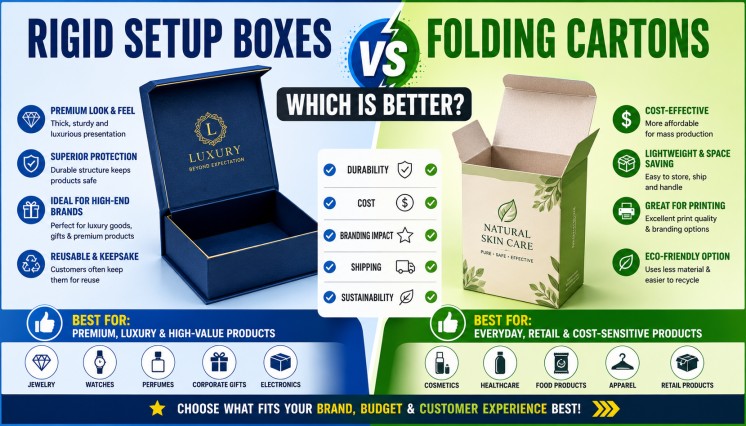
When choosing packaging for a product, the box itself can influence how customers perceive what is inside. Two of the most widely used options are rigid setup boxes and folding cartons. Both can be custom printed, branded, and manufactured in a wide range of sizes, but they serve very different packaging needs.
So, rigid setup boxes vs folding cartons – which is better?
The answer depends on your product, budget, brand positioning, storage requirements, shipping needs, and the customer experience you want to create. Rigid setup boxes are generally the better choice for luxury, premium, gift, and presentation-focused products, while folding cartons are often more practical for lightweight products, high-volume retail packaging, and businesses focused on minimizing packaging costs and storage space.
This guide compares the two packaging formats in detail so you can choose the right solution for your product and brand.
What Are Rigid Setup Boxes?
Rigid setup boxes are premium packaging boxes manufactured from thick, sturdy paperboard, commonly known as rigid board. Unlike folding cartons, they are generally manufactured in a fixed shape rather than being supplied as a flat carton that the customer folds into shape.
The thick construction gives them a substantial feel in the hand. This makes them particularly popular for products where packaging is part of the overall customer experience.
Common examples include:
- Luxury rigid boxes
- Rigid gift boxes
- Custom jewelry boxes
- Perfume boxes
- Cosmetic packaging boxes
- Watch boxes
- Electronics packaging
- Apparel and accessory packaging
- Premium retail packaging
- Corporate gift boxes
Rigid boxes can also incorporate features such as magnetic closures, ribbon pulls, custom inserts, windows, foil stamping, embossing, debossing, spot UV, and specialty papers.
Why Do Brands Choose Rigid Boxes?
The main advantage is perceived value.
A thick, well-constructed box immediately feels different from lightweight packaging. That physical experience can support a premium brand positioning and make the unboxing process more memorable.
For luxury products, this matters because customers aren’t only buying the product—they are buying the experience surrounding it.
What Are Folding Cartons?
Folding cartons are lightweight paperboard packages manufactured from printed carton stock and supplied in a flat or collapsed form. They are die-cut, creased, folded, and glued into their final shape.
They are extremely common in retail because they offer an efficient balance of:
- Cost
- Print quality
- Storage
- Transportation
- Customization
- Production speed
You will find custom folding cartons around products such as cosmetics, food, pharmaceuticals, electronics accessories, household products, toys, and personal-care items.
Unlike rigid boxes, folding cartons can be shipped and stored flat before assembly. That can significantly reduce the space required throughout the packaging supply chain.
Construction: Rigid Boxes vs Folding Cartons
The construction method is one of the most important differences between the two.
A rigid setup box typically uses a thick paperboard core wrapped with printed or decorative paper. The board creates the structural strength, while the outer wrap provides the branding and visual finish.
Folding cartons use thinner paperboard that is scored and die-cut so it can fold into the desired shape.
This means:
Rigid setup boxes = structure first.
Folding cartons = efficient folding construction first.
Neither construction is universally better. The right choice depends on what your packaging needs to accomplish.
Which Is More Durable?
If durability is the priority, rigid setup boxes generally have the advantage. Their thick board construction provides greater resistance to bending, crushing, and everyday handling compared with lightweight folding cartons.
That makes rigid packaging particularly useful for:
- Fragile products
- Heavy products
- High-value items
- Products requiring additional protection
- Luxury goods
- Gift sets
- Reusable packaging
Folding cartons can still provide adequate protection for many products, particularly when the product itself is sturdy or when an insert is used. However, they are not normally selected when maximum structural strength is the primary requirement.
Which Looks More Premium?
This is where rigid packaging really stands out.
A custom rigid box can create a substantial, luxury feel before the customer even sees the product. The thickness of the board, clean edges, precise construction, and high-end finishing options all contribute to the presentation.
For example, a rigid box can be finished with:
- Gold or silver foil
- Embossing
- Debossing
- Spot UV
- Soft-touch coating
- Matte or gloss finishes
- Textured papers
- Custom inserts
- Ribbon closures
- Magnetic closures
- Specialty wrapping papers
Folding cartons can also look highly sophisticated. High-quality printing and finishing can transform an ordinary carton into attractive retail packaging.
However, when the goal is to communicate luxury, exclusivity, or high perceived value, rigid setup boxes generally have the edge.
Which Packaging Option Is More Affordable?
In most cases, folding cartons are more economical than rigid setup boxes.
Rigid packaging requires thicker materials and a more involved manufacturing process. It also takes up more space during shipping and storage because the boxes typically maintain their shape.
Folding cartons are designed around production and logistical efficiency. They can be manufactured flat, transported flat, and assembled when needed.
This makes folding cartons especially attractive for:
- Large production runs
- Everyday retail products
- Subscription products
- Promotional packaging
- Cost-sensitive brands
- High-volume consumer goods
However, packaging cost should not be judged only by the price per box.
A premium rigid box may have a higher unit cost but provide greater perceived product value, stronger branding, and a more memorable unboxing experience.
The better question is:
What return do you expect your packaging to create?
Rigid Setup Boxes vs Folding Cartons for Branding
Both formats provide significant branding opportunities, but rigid boxes offer more room for creating a premium physical experience.
With custom rigid packaging, brands can combine structural design with printing and finishing to create packaging that feels closely connected to the product identity.
For example, a luxury skincare company might use a rigid box with a custom insert, textured paper, foil logo, and magnetic closure.
A mass-market skincare company might choose a folding carton with high-quality graphics, product information, and a clean retail-friendly design.
Both can communicate a strong brand message. The difference is the type of experience they create.
Which Offers More Customization?
Both rigid setup boxes and folding cartons can be customized extensively.
Rigid Box Customization
Rigid packaging can be customized through:
- Box dimensions
- Box shapes
- Lid styles
- Magnetic closures
- Ribbon closures
- Drawer mechanisms
- Shoulder-neck construction
- Hinged lids
- Custom inserts
- Foam inserts
- Paperboard inserts
- Windows
- Specialty papers
- Foil stamping
- Embossing and debossing
- Spot UV
- Custom printing
Folding Carton Customization
Folding cartons can also be customized through:
- Die-cut shapes
- Tuck-end styles
- Auto-bottom construction
- Lock-bottom designs
- Window cutouts
- Custom dimensions
- Full-color printing
- Foil finishes
- Embossing
- Spot UV
- Matte and gloss coatings
- Special opening mechanisms
The major difference is that rigid boxes provide more structural freedom for creating a substantial, premium package.
Which Is Better for Shipping and Storage?
This is one category where folding cartons usually win.
Because folding cartons can be supplied flat, they occupy significantly less storage space before assembly. This can be especially useful for brands with limited warehouse capacity.
Rigid boxes, on the other hand, generally maintain their finished form. Their larger shipping and storage footprint can increase logistical requirements.
For businesses distributing large quantities of packaging, this difference can become important.
Folding Cartons Are Usually Better When:
- Warehouse space is limited
- Packaging needs to be stored flat
- Large quantities are ordered
- Transportation efficiency is important
- Boxes are assembled close to the point of use
Rigid Boxes Are Usually Better When:
- Premium presentation matters more than compact storage
- The packaging needs to protect a high-value item
- The box will be reused
- Packaging is part of the product experience
Which Is More Sustainable?
Sustainability depends on more than whether packaging is rigid or folding.
Important factors include:
- Material selection
- Recycled content
- Responsible sourcing
- Printing processes
- Coatings
- Adhesives
- Packaging weight
- Transportation
- Reusability
- End-of-life recycling
Folding cartons can have a logistical advantage because their flat form can reduce transportation and storage volume.
Rigid boxes can have an advantage when they are designed for reuse. A well-made rigid gift box may continue serving as storage packaging long after the original product has been removed.
Therefore, there is no universal rule that one format is always more sustainable.The better approach is to evaluate the complete packaging lifecycle, from raw material sourcing through manufacturing, transportation, customer use, reuse, and disposal.
Which Is Better for E-Commerce Packaging?
For e-commerce brands, the answer depends on the product and the role of the box.
A rigid box can create an impressive unboxing experience, especially for premium products. However, the outer shipping package may still need additional protection because the retail box itself may be designed primarily for presentation.
Folding cartons can be practical for lightweight products, particularly when they are placed inside a protective shipping mailer or corrugated shipping box.
For high-end e-commerce brands, a combination can work extremely well:
Rigid presentation box + protective outer shipping box
This allows the inner packaging to focus on branding while the outer package handles transportation protection.
Rigid Setup Boxes vs Folding Cartons for Luxury Products
If you sell a premium or luxury product, rigid packaging is often the stronger choice. Luxury packaging needs to communicate quality before the customer uses the product. The physical weight and structure of a rigid box can contribute significantly to that perception.
Products commonly suited to luxury rigid packaging include:
- Premium cosmetics
- Perfumes
- Jewelry
- Watches
- Fashion accessories
- Luxury apparel
- High-end electronics
- Gourmet gift sets
- Corporate gifts
A folding carton can still work for luxury products, particularly when the design and finishing are exceptional. But rigid construction gives brands another layer of physical differentiation.
When Should You Choose Folding Cartons?
Choose folding cartons when your priorities are primarily cost efficiency, storage efficiency, retail distribution, and high-volume production.
They are especially suitable when:
- The product is lightweight
- The product doesn’t require heavy structural protection
- Packaging must be stored flat
- You need economical, large-volume packaging
- Products are sold through retail shelves
- Packaging needs extensive product information
- Transportation efficiency is important
For many consumer products, folding cartons provide an excellent combination of appearance and practicality.
When Should You Choose Rigid Setup Boxes?
Choose rigid setup boxes when presentation, durability, and perceived value are more important than minimizing packaging cost and storage space.
They are particularly appropriate when:
- Your product is premium or luxury
- Packaging is part of the customer experience
- You want a memorable unboxing experience
- The product needs stronger structural support
- You want reusable packaging
- You need premium inserts
- Your brand relies heavily on visual presentation
- You want packaging that feels substantial
For brands competing in premium categories, the packaging itself can become part of the product’s perceived value.
Rigid Setup Boxes vs Folding Cartons: Quick Comparison
| Feature | Rigid Setup Boxes | Folding Cartons |
| Construction | Thick, sturdy paperboard structure | Lightweight folding paperboard |
| Durability | Excellent | Moderate |
| Premium appearance | Excellent | Good to excellent |
| Product protection | High | Moderate |
| Flat shipping | Usually no | Yes |
| Storage efficiency | Lower | Excellent |
| Production cost | Higher | Lower |
| Customization | Extensive | Extensive |
| Luxury products | Ideal | Suitable for some products |
| Retail shelves | Suitable | Excellent |
| Gift packaging | Excellent | Good |
| Reusability | High | Usually limited |
| Inserts | Easy to integrate | Available |
| Branding potential | Very high | High |
| Best for | Luxury and premium products | Mass-market and lightweight products |
The biggest difference is simple: rigid setup boxes are built for structure and presentation, while folding cartons are built for efficiency and flexibility.
Rigid Setup Boxes vs Folding Cartons: Which Is Better?
There is no single winner because the two packaging formats are designed around different priorities.
Rigid setup boxes are better for luxury, durability, presentation, and premium branding.
Folding cartons are better for affordability, storage efficiency, high-volume production, and retail practicality.
Here’s the simplest way to decide:
| If Your Priority Is… | Better Choice |
| Luxury presentation | Rigid setup box |
| Lowest packaging cost | Folding carton |
| Maximum structural strength | Rigid setup box |
| Flat storage | Folding carton |
| Premium unboxing | Rigid setup box |
| Large-volume retail | Folding carton |
| Reusable packaging | Rigid setup box |
| Efficient transportation | Folding carton |
| High-end gift packaging | Rigid setup box |
| Extensive product information | Folding carton |
| Custom inserts | Rigid setup box |
| Mass-market products | Folding carton |
Can You Combine Rigid Boxes and Folding Cartons?
Absolutely.
Some brands use both packaging formats at different points in their product range or supply chain.
For example, a company might use folding cartons for its standard product line and rigid boxes for premium collections, limited editions, holiday gift sets, or special launches.
This approach allows brands to maintain packaging consistency while matching the packaging investment to the value and positioning of each product.
How to Choose the Right Packaging for Your Brand
Before ordering custom packaging, consider these seven questions:
- What type of product are you packaging?
- How much protection does it need?
- What is your packaging budget?
- How important is a premium presentation?
- Where will the packaging be stored?
- How will it be transported?
- What experience do you want customers to have?
If your answers point toward premium presentation and protection, custom rigid boxes may be the better investment.
If efficiency, affordability, and compact storage are more important, custom folding cartons may be the smarter solution.
Get Custom Rigid Setup Boxes for Your Brand
The right packaging should do more than hold a product. It should protect what you sell, communicate your brand identity, and create an experience customers remember.
At Custom Rigid Boxes, we manufacture custom rigid packaging designed around your product, brand, and packaging requirements. From dimensions and structural styles to custom inserts, premium printing, and luxury finishes, you can create a box that looks and feels purpose-built for your product.
Whether you’re launching a luxury product, upgrading existing packaging, developing retail packaging, or creating premium gift boxes, our team can help you determine the right rigid box style, materials, dimensions, and finishing options.
Ready to upgrade your packaging? Get a custom quote and turn your product packaging into part of the customer experience.
FAQs
Rigid setup boxes are better when durability, luxury presentation, and premium branding are the main priorities. Folding cartons are generally better for cost efficiency, flat storage, and high-volume retail packaging.
Generally, yes. Rigid boxes use thicker materials and require a more involved manufacturing process, while folding cartons are designed for efficient production and flat transportation.
Folding cartons provide good protection for many lightweight and moderately fragile products, but they generally do not offer the same structural strength as thick, rigid setup boxes.
Yes. High-quality printing, foil stamping, embossing, specialty coatings, and creative structural designs can make folding cartons look premium. However, rigid boxes naturally provide a more substantial luxury feel.
Many rigid boxes can be reused because their sturdy construction allows customers to repurpose them for storage. This can also extend the useful life of the packaging.
It depends on the product. Rigid boxes are excellent for premium unboxing experiences, while folding cartons can be more efficient for lightweight products. Both may require an additional protective shipping package depending on the product and delivery conditions.
Yes. Both formats can be customized in terms of dimensions, printing, finishes, structural design, and inserts. Rigid boxes generally provide greater opportunities for premium structural features and presentation.
The main difference is construction. Rigid boxes use thick board to create a sturdy, usually pre-formed structure, while folding cartons use thinner paperboard that is die-cut and folded into shape.
