 sales@customrigidboxes.com
 (631) 250-5009


How Are Rigid Boxes Made? From Greyboard Cutting to Final Assembly
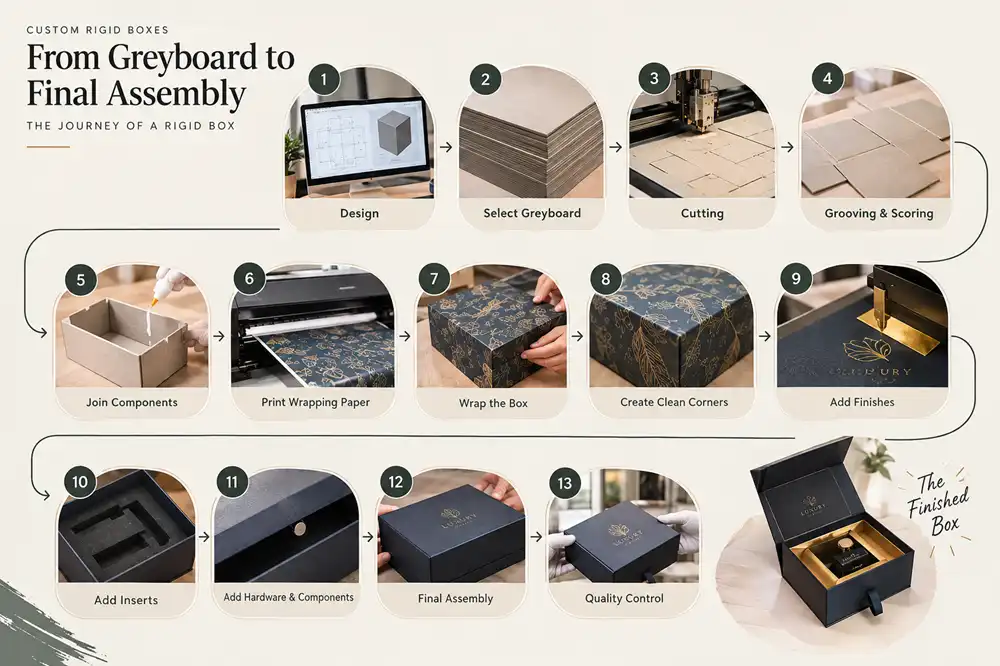
Rigid boxes appear simple in the hands of their customers, yet the manufacturing process of producing such boxes is quite exacting. Whereas folding cartons are produced from paperboard folded into shapes, rigid boxes are made from thick paperboard that has been cut, wrapped, finished, and put together to make a robust and premium product.
So, how are rigid boxes made?
The process usually entails choosing and cutting greyboard, scoring or grooving, paper wrapping, printing, and finishing, putting the components together, and inspecting the quality. All these steps impact the strength, look, fit, and overall presentation of the box.
From jewelry boxes and magnetic boxes to perfume boxes and gift boxes, the manufacturing process is flexible and can be tailored to accommodate product and brand needs.
This article provides an insight into the rigid box manufacturing process.
What Are Rigid Boxes Made From?
Before delving into the production process, it is first necessary to know what really constitutes a rigid box.
Greyboard, otherwise known as chipboard or rigid board, is mostly used in the making of rigid boxes. The dense paperboard gives the structure of the box.
In addition to the greyboard, manufacturers will incorporate:
- Printed wrapping paper
- Coated paper
- Special papers
- Kraft paper
- Textured or fabric coverings
- Foil
- Magnets
- Ribbons
- Foam inserts
- Paperboard inserts
- EVA or molded inserts
The greyboard gives strength while the cover gives the identity.
How Are Rigid Boxes Made Step by Step?
The exact process varies according to the box style, but most custom rigid packaging follows a sequence similar to this:
Design → Greyboard cutting → Grooving → Board assembly → Paper printing → Wrapping → Finishing → Component assembly → Inserts → Quality control
Each stage needs to be coordinated carefully because even a small measurement error can affect the final box.
Let’s break down the process.
1. Designing the Rigid Box
Manufacturing begins way before the cutting of the first piece of greyboard takes place. Packaging is designed considering the size, weight, and use of the product.
At this stage, manufacturers decide on:
- Length, breadth, and height of the box
- Wall thickness
- Construction of lid
- Opening mechanism
- Inserts
- Closure mechanism
- Material specifications
- Printable areas
- Finishing specifications
Common rigid box designs are two-piece rigid boxes, magnetic boxes, book boxes, drawer boxes, shoulder neck boxes, clamshell boxes, and telescopic boxes.
The design has to be functional besides being appealing.
2. Selecting the Greyboard
After determining the design, the right greyboard thickness and quality are chosen.
Greyboard is a dense, rigid paper board which provides stiffness to the package.
The greyboard thickness varies based on:
- Dimensions of the box
- Weight of the product
- Rigidity desired
- Style of the box
- Nature of lid construction
- Nature of insert
- A premium look
Thicker greyboards are used for bigger boxes, while smaller boxes may use a thinner board, depending upon the application.
It is all about using a board which offers sufficient rigidity without wasting material.
3. Cutting the Greyboard
The next stage is one of the most critical manufacturing steps, which is cutting greyboard.
Large-sized boards are cut into precise sizes in accordance with the box design.
Usually, the rigid box needs the following pieces:
- Base
- Lid
- Side walls
- End walls
- Supports inside the box
- Neck pieces
Depending on the specific production process, the cutting may be carried out with the help of cutting machines and dies.
4. Grooving and Scoring the Board
Sometimes certain rigid box structures must have grooves or channels cut into the greyboard.
The grooves help create a point of fold or a space between the sections of the board.
A rigid box is not a folding carton because the rigid box does not consist of a single sheet that is simply folded up.
The grooving allows the manufacturer to create good edges on the box.
This is especially true when making book-style or hinged rigid boxes.
5. Joining the Greyboard Pieces
The assembled boards are now ready for grooving and cutting.
After applying adhesive to appropriate areas and positioning the parts properly, the formation of the box structure takes place.
The producer must make sure that:
- Corners are correctly aligned
- Edges are straight
- Dimensions of the box are maintained
- Adhesive is uniformly applied
- Panels do not come apart
This is when the rigid box starts taking its shape.
The box still looks unadorned because greyboards have not been covered with the decorative cover yet.
6. Printing the Wrapping Paper
The external layer accounts for most of the visual appeal of the box.
This paper may have the following printed on it for the brand:
- Logo
- Colors
- Designs
- Information about the product
- Pictures
- Text
- Branding
Depending on the design, various types of printing processes may be applied to the paper.
For premium packaging, the printing process may be supplemented by other finishing options, including foil stamping, embossing, debossing, spot varnish, matte coating, or gloss coating.
7. Wrapping the Rigid Box
The printed paper is then applied to the greyboard construction.
It is referred to as paper wrapping or case making in some cases.
An adhesive is applied to the correct spots, and the wrapping paper is positioned around the board.
The paper should fit around the corners and edges without any:
- Wrinkles
- Bubbles of air
- Inconsistent overlapping
- Showing of the board
- Misaligned images
This is important for corners, which are very noticeable on the completed packaging.
8. Creating Clean Corners and Edges
Corners are just one of those little details that turn out to be quite significant in terms of premium packaging.
When making rigid boxes, the covering material is bent and fastened around the cardboard.
This way, we aim to create:
Straight edges + sharp corners + smooth surfaces + consistent coverage
If corners are poorly processed, they will ruin the appearance of any fancy packaging regardless of the cost.
Quality control during this stage is crucial for luxury boxes since the packaging becomes part of your first impression.
9. Adding Premium Finishes
Once the basic wrapping is done, further finishing can be added to it, based on the requirements of the design.
Some of the common rigid box finishing techniques are:
Foil Stamping
Metals can be stamped onto the logos, fonts, borders, or any other part. Gold, silver or any other foil technique can make the boxes look distinctive.
Embossing
The embossing technique involves giving a raised effect to certain parts of the box. It is commonly used on logos and other premium brand details.
Debossing
A debossed effect involves making indentations in certain parts using a press. It gives a subtle and sophisticated look to the boxes.
Spot UV
The Spot UV process involves giving gloss to certain areas of the boxes instead of coating the whole surface with it.
Specialty Papers
Textured paper, linen paper, soft-touch paper, colored paper, and other specialty papers can also be used to create a specific look.
10. Adding Magnets, Ribbons, and Other Components
Sometimes, certain stiff box designs require additional hardware.
Such as, magnetic closure boxes have hidden magnets that help the lid to close properly.
The other type of design may include the following:
- Ribbon Pulls
- Ribbon Hinges
- Elastic Closures
- Metal Pieces
- Handles
- Decoration Panels
- Foam Inserts
- EVA Inserts
- Paper Die-Cut Inserts
11. Installing Custom Inserts
The package does not always need to enclose its contents in just any way.
The custom insert that is made especially for the particular product may be used.
Typical materials of the insert are:
- EVA foam
- Foam
- Paperboard
- Cardboard
- Molded pulp
- Covered board
For instance, the box with jewelry would have different compartments for rings, necklaces, and earrings. The box with perfume may have a particular shaped insert in order to position the bottle correctly.
12. Final Assembly
Once the major components, covers, finishes, magnets, ribbons, and inserts are done, the individual parts are assembled.
This assembly process may include the following:
- Placing the base
- Fitting the cover
- Adding closures
- Fixing the inserts
- Aligning the parts
- Cleaning the outside
- Opening and closing the box
The flat sheets and individual components have now become a ready-to-use customized rigid box.
13. Quality Control and Inspection
Before the packaging goes through the approval process to be delivered, it needs to be subject to quality testing.
Some of the things that can be tested include:
- Dimensions
- Board straightness
- Corner quality
- Paper wrapper
- Print quality
- Position of logo
- Finishing
- Closure fit
- Magnetic closure
- Placement of inserts
- Adhesive quality
Consistency of quality becomes an even bigger factor when producing bulk orders.
Having a beautifully made sample does not help much if the production order differs significantly from it.
How Long Does It Take to Make Rigid Boxes?
This depends on certain aspects like box style, volume of orders, material, printing, finishes, inserts, and customizations.
An example of a basic rigid box with limited finish will have fewer steps in production than an extremely customized box with magnetic closures and specialized papers and finish techniques.
The process may therefore include separate timelines for:
Design → Sampling → Material preparation → Production → Finishing → Assembly → Quality control → Shipping
Planning these stages early can help prevent delays, especially for businesses ordering custom packaging for a product launch or seasonal campaign.
What Makes Rigid Boxes Different From Folding Cartons?
The most prominent difference between the two packaging types lies in structural construction.
Folding cartons consist of relatively thin board that is transported to the consumer unfolded before taking on its finished form upon folding.
In contrast, rigid boxes are made of thicker board and put together in a more lasting structure.
This makes rigid packaging very solid and explains why it is especially widely used for those products whose presentation is an essential element of the customer experience.
Among the common applications of rigid boxes are:
- Jewelry
- Watches
- Perfumes
- Cosmetics
- Electronics
- Luxury presents
- High-quality candles
- Promotional products
- Retail products of high value
However, it does not necessarily mean that rigid packaging is the perfect choice for all the products.
Build a Rigid Box Around Your Product
A well-designed rigid box, it requires more than just a logo and box dimensions. The right board, structure, wrap, finish, closure, and insert have to go hand in hand.
Custom Rigid Boxes specializes in custom packaging design that suits both the product and the requirements of your branding. Whether it is an easy-to-design two-piece structure or a sophisticated luxury box with custom inserts and finishes, we cater to all types.
The outcome must be a box design that does not simply hold your product, but packages it deliberately.
How about designing your own rigid packaging? Contact us now for a quote on your box specifications.
FAQs
1. How are rigid boxes made?
Rigid boxes are made by cutting and assembling thick greyboard, covering the structure with printed or specialty paper, adding finishes and components, fitting in inserts, and doing final inspection.
2. What material is used to make rigid boxes?
The structure of rigid boxes is made from thick greyboard, chipboard, or any other rigid paperboard. This is then covered with printed or specialty paper, fabric, or any other finishing material.
3. Are rigid boxes stronger than folding cartons?
The structure of rigid boxes is usually stronger than folding cartons because rigid boxes have a more substantial structure.
4. Can rigid boxes be customized?
Yes. Rigid boxes are customizable in terms of their structure, finishes, color schemes, shapes, sizes, closures, inserts, materials, and printing.
5. What are rigid boxes commonly used for?
Some applications of rigid boxes include jewelry, watches, cosmetics, perfumes, candles, electronics, premium gifts, promotional items, and other premium retail products.
