 sales@customrigidboxes.com
 (631) 250-5009


Types of Custom Inserts for Rigid Boxes
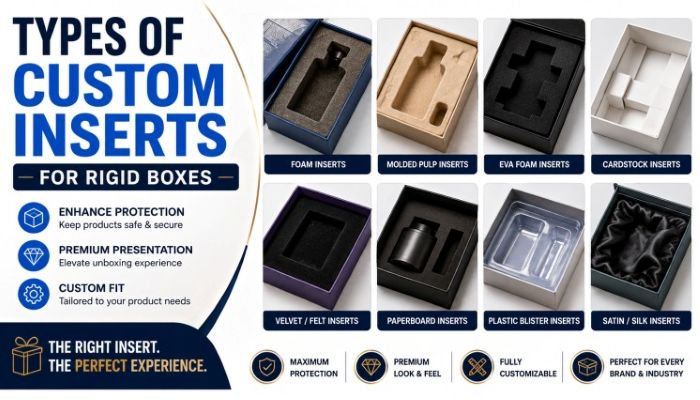
Luxury packaging is not limited to making a great-looking box; it means giving customers an amazing unboxing experience without compromising product safety. This is where custom inserts for rigid boxes become useful.
No matter whether you package jewelry, makeup products, electronics, candles, watches, perfumes, or gifts, using a suitable insert turns an ordinary rigid box into premium packaging which will provide necessary protection, organization, and presentation of products.
Custom inserts are specially made for holding products firmly within the packaging, thus preventing any product movement during transportation and arranging all items nicely upon opening the box. Inserts not only improve protection but make products more professional and better-looking.
As there are many different materials and design options available for custom inserts, deciding on which one to choose becomes quite a challenging task. Each type provides its own benefits according to your product, budget, environmental preferences, and branding needs.
In this article, we will analyze the most common custom inserts for rigid boxes along with their benefits, applications, and tips on how to choose the best insert.
What Are Custom Inserts for Rigid Boxes?
Custom inserts are specialized interior parts that are specifically designed to be fitted into rigid boxes in order to safely hold one or more items. Rather than moving about freely within the box, custom inserts create designated spaces to house the item(s).
Different from conventional fillers used for packaging, custom inserts are specifically designed in accordance with the shape of the product.
Based on the packaging needs you may have, custom inserts can be made of the following materials:
- Foam
- Paperboard
- Corrugated cardboard
- Molded pulp
- Plastic
- EVA
- Covered boards with fabric
- Sponge
- Felt
- Velvet
- Satin
- Layered materials
Why Are Custom Inserts Important?
Most businesses concentrate on designing visually appealing rigid boxes but fail to appreciate the importance of the insert in them. However, in truth, it is the insert that protects the product throughout its customer journey.
Good inserts help businesses achieve many things like:
- Protecting from scratches and damage
- Minimizing movement while shipping
- Making the unboxing experience memorable
- Keeping multiple products organized together
- Increasing the perceived value of the product
- Supporting premium branding
- Reducing returns due to shipping damages
- Creating memorable experiences for customers
For luxury brands, the insert becomes almost as important as the box itself.
Different Types of Custom Inserts for Rigid Boxes
Every product has unique packaging requirements. Below are the most widely used insert options for rigid box packaging.
1. EVA Foam Inserts
One of the most popular insert materials for rigid boxes of high quality is known as EVA (Ethylene Vinyl Acetate) foam. It provides the best combination of cushioning and elegance, which makes it a material of choice for luxurious goods.
In comparison to usual foam, the structure of EVA foam is denser and resistant to compression.
Applications
EVA foam inserts are commonly used for:
- Luxury watches
- Jewelry
- Smartphones
- Electronics
- Medical equipment
- Camera accessories
- High-end promotional kits
Advantages
- Superior protection
- Long-lasting performance
- Elegant appearance
- Highly customizable
- Suitable for expensive products
Considerations
EVA foam is generally more expensive than cardboard or paperboard inserts, making it better suited for premium packaging rather than budget-friendly retail boxes.
2. PE Foam Inserts
Another material that can be used for rigid box packaging is polyethylene (PE) foam, which is especially useful if the items being packaged need greater impact resistance when transported.
PE foam is tougher than EVA foam and does a great job in industrial and commercial packing.
Common Uses
- Electronics
- Lab equipment
- Industrial tools
- Car parts
- Delicate accessories
Companies that ship fragile items to long distances prefer to use PE foam as it ensures protection from impact and vibrations.
Advantages
- Good cushioning properties
- Robust construction
- Lightweight
- Chemical and water resistant
Limitations
While being very protective, polyethylene foam has an industrial look that is not as good for presenting luxury items, unlike EVA foam, unless wrapped in fancy cloth.
3. PU Foam Inserts
The PU (Polyurethane) foam is softer compared to the EVA and PE foams, thus it provides a gentle cushion for lightweight and delicate products.
The soft nature of the foam makes it perfect for high-end presentation, which needs both comfort and aesthetics.
Best For
- Cosmetics
- Decorative objects
- Glass products
- Gift sets for cosmetics
- Delicate collectibles
The PU foam may also be covered with velvet or satin fabric to give an elegant interior to the packaging.
Benefits
- Soft cushioning
- Aesthetic
- High product presentation
- Die cut capabilities
- Affordable for many luxury products
Drawbacks
The PU foam is less durable compared to the EVA and PE foams.
4. Cardboard Inserts
Among other packaging materials, cardboard inserts are the most affordable and environmental-friendly choice.
It is made of durable paper-based material and can be easily transformed into customizable compartments without foam.
Most of the businesses choose cardboard inserts as they offer an excellent balance between protection, environment friendliness, and price.
Common Industries
Industries that use cardboard inserts include:
- Cosmetics
- Clothing packages
- Gift boxes for food
- Candles packaging
- Office supplies
- Subscription boxes
- Corporate gifts packaging
Companies that want to decrease their plastic usage will find cardboard inserts an appealing choice.
Advantages
- Eco-friendly material
- Cost-effective production
- Great printability
- Customized compartment design
- Recyclable
Limitations
Cardboard inserts have moderate protection properties.
5. Corrugated Inserts
Corrugated inserts are meant for those products that need extra support during transportation. They are made of fluted corrugated board and therefore have higher strength than ordinary cardboard.
They are particularly ideal for online businesses delivering fragile goods over long distances.
Benefits
- High compressive strength
- Effective shock absorption
- Light weight
- Environmentally friendly
- Cost effective
Suitable Products
- Glassware
- Ceramics
- Bottles
- Electronics
- Kitchenwares
- Multiball gifts sets
The multiple layers help in distributing shock evenly, hence reducing chances of damage to the products.
6. Molded Pulp Inserts
With sustainability becoming more and more relevant to packaging design, molded pulp inserts have become one of the fastest-growing solutions, which have taken the place of foam and plastic inserts.
Molded pulp inserts are created from recycled paper, cardboard, or natural materials and provide decent cushioning qualities while having no negative effect on the environment.
Applications
- Consumer electronics
- Bottles of wine
- Packaging for cosmetics
- Decorative items for homes
- Glass items
- Sustainable gift packaging
Advantages
- Provides environmentally friendly packaging
- Good product protection
- Cost-effective for large-scale production
- Helps create a sustainable brand image
Limitations
Unlike foam inserts, molded pulp does not provide many luxury finishes.
7. Vacuum-Formed Plastic Inserts
The vacuum-formed inserts are made from heated plastic sheeting and molding over custom molds via vacuum-forming process. The outcome is a durable insert which firmly grips the products while showing them off in a neat and structured arrangement.
This type of inserts works best when the visibility of the product is a key component of the packaging design.
Common Materials
- PET
- PVC
- RPET (Recycled PET)
Applications
- Electronics
- Beauty items
- Toys
- Marketing packages
- Medical items
- Retail display packaging
Benefits
- Perfect fit of the product
- Durable structure
- Moisture resistant
- Professional look
- Transparent and colored
Limitations
Some types of plastics have more negative effects on the environment than paper products, even though there are recycled PET variants available.
8. Thermoformed Inserts
Thermoformed inserts are frequently mistaken for vacuum-formed inserts; however, they provide more versatility in terms of designing and can fit complex product shapes better.
This type of insert is specifically designed to fit complex dimensions of products, ensuring stability and presentation.
Ideal For
- Luxury electronics
- Luxury cosmetics
- Medical devices
- Collectibles
- High value accessories
Advantages
- Perfect fit
- Professional look
- Durable
- Great for multiple products
Limitations
Thermoformed inserts are normally custom made inserts and thus are more suited for medium to large scale productions.
9. Velvet Inserts
Use of velvet inserts makes the packaging look extremely valuable immediately.
The silky touch makes the product look elegant while safeguarding delicate surfaces from scratches.
Luxury brands often use a combination of velvet and foam inserts for luxury and safety.
Uses
- Jewelry boxes
- Watch boxes
- Award packaging
- Luxury pens
- Collectibles
- Luxury accessories
Benefits
- Premium look
- Silky touch
- Scratch resistant
- Improves customer experience
Considerations
Velvet material needs extra care during production and handling due to its ability to accumulate dust.
10. Satin Inserts
Satin inserts add an elegant touch to gift packing. The satin fabric is typically used as a decoration wrap rather than an insert.
This smooth and shiny material creates an elegant presentation that adds an emotional value to the unboxing experience.
Applications
- Bridal gifts
- Luxury perfumes
- Jewelry
- Corporate gifts
- Wedding favors
- Limited edition products
Benefits
- Elegant presentation
- Soft cushioning
- Perfect for luxury branding
- Available in different colors
11. Silk Inserts
Silk inserts can be considered the most luxurious interior finish for rigid boxes. With their beautiful look, silk inserts are perfect for collections and luxury retail packaging.
Unlike other materials, which provide structural strength, silk is normally placed on top of foam and paperboard inserts.
Uses
- Design Jewelry
- Luxury Watches
- Premium Gift Boxes
- Collectible Items
- Promotional Packaging
Advantages
- Premium Look
- Smooth Surface
- Unforgettable Unboxing Experience
- Great Brand Image
12. Sponge Inserts
The sponge inserts have high flexibility and compression capability, thus ideal for use in goods that do not have consistent shapes.
The cushioning nature of the sponge helps in shock absorption during transit.
Suitable For
- Bottles
- Cosmetics
- Fragile decorations
- Electronic accessories
- Gifts
Advantages
- High shock absorption capability
- Low weight
- Flexible
- Cost effective
13. Die-Cut Inserts
Die-cut inserts are those inserts that are made using precise cutting technology, rather than any particular material. They can be made from foam, cardboard, paperboard, corrugated board, or any other material.
Their primary advantage lies in their capability of fitting perfectly into the dimensions of the packaged item.
Advantages
- Perfect fit
- Professional look
- Maximum security of the product
- Suitability with different materials
- Can hold one or more products
Almost every high-quality rigid box requires custom-made die-cut inserts.
14. Multi-Layer Inserts
Certain products require varying degrees of protection within the same package. Multilayer inserts resolve this issue through the use of multiple layers of foam, paperboard or fabric material.
For instance, the topmost layer could be used to showcase the main product while others could be used for accessories, user manuals, cords or replacement parts.
Uses
- Mobile phone packing
- Gift sets
- Electronics
- Medical devices
- Collectible editions
Advantages
- Improved organization
- Superior unboxing experience
- Extra storage space
- Enhanced product protection
15. Combination (Hybrid) Inserts
Most luxury brands today don’t use only one type of insert material anymore. They use different combinations of materials to provide for the best ratio of protection, visual appeal, sustainability, and economy.
Some of the most common combinations are:
- EVA foam covered in velvet
- Cardboard with a satin lining
- Molded pulp plus paperboard sleeves
- Foam inserts plus fabric covers
- Corrugated base and decorative top layer
Using hybrid inserts, luxury brands can create beautiful yet highly efficient packages.
Comparison of Different Types of Custom Inserts for Rigid Boxes
| Insert Type | Protection | Luxury Appearance | Eco-Friendly | Best For |
| EVA Foam | Excellent | Excellent | No | Watches, electronics, jewelry |
| PE Foam | Excellent | Good | Limited | Industrial products, electronics |
| PU Foam | Very Good | Excellent | Limited | Cosmetics, perfumes |
| Cardboard | Moderate | Good | Excellent | Retail packaging |
| Corrugated | High | Moderate | Excellent | Shipping and eCommerce |
| Paperboard | Moderate | Good | Excellent | Cosmetics, gifts |
| Molded Pulp | High | Natural | Excellent | Sustainable packaging |
| Vacuum-Formed Plastic | High | Excellent | Moderate | Retail display |
| Thermoformed Plastic | High | Excellent | Moderate | Luxury electronics |
| Velvet | Low | Premium | Depends | Jewelry |
| Satin | Low | Premium | Depends | Gift packaging |
| Silk | Low | Luxury | Depends | High-end products |
| Felt | Moderate | Premium | Moderate | Watches, accessories |
| Sponge | High | Good | Limited | Fragile products |
| Die-Cut | Depends on material | Excellent | Depends | Custom packaging |
| Hybrid Inserts | Excellent | Premium | Depends | Luxury brands |
How to Choose the Right Insert for Your Rigid Box
Choosing an insert is not just about looks. Consider these criteria when you make your decision:
Weight of the Product
Heavy products should be wrapped in durable inserts made from materials such as EVA foam, PE foam, or corrugated material, while lighter products can easily be protected with paperboard or cardboard inserts.
Vulnerability to Damage
Fragile products, glass, ceramics, electronics, and accessories are best packed in foam and molded inserts that absorb shocks and prevent any movement.
Brand Image
Luxury goods and companies tend to opt for luxurious materials to give an unforgettable unboxing experience to the customers. Eco-friendly products will suit molded pulp and paperboard inserts to show their environmental approach.
Shipping Conditions
For products shipped for a long distance or through eCommerce platforms, inserts with good shock absorption are needed to reduce vibration during transportation. Foam, corrugated, and molded pulp inserts have more protective features than decorative fabric inserts.
Budget
Cost-effective inserts are cardboard and paperboard inserts, and custom foam and fabric-wrapped inserts are pricier.
Final Thoughts
Not only do custom inserts hold products, but they also improve the unboxing experience, protect during transit, and reinforce the high-quality nature of your packaging by choosing the right materials and design. You can have rigid boxes made with an elegant finish that is sure to impress customers as well as provide safety for the products in your box.
Our team at Custom Rigid Boxes can work on your custom designs to build your rigid boxes with inserts that are designed specifically for your products. From luxury retail packaging to corporate gifting to e-commerce packages, we have the expertise to help you craft your perfect rigid box packaging solution. Contact us now!
FAQs
Custom inserts are specially designed interior holders that keep products securely in place inside rigid boxes. They improve product protection, organization, and the overall unboxing experience.
EVA foam and PE foam inserts provide the highest level of cushioning and shock absorption, making them ideal for fragile, valuable, or high-end products like electronics, jewelry, and medical devices.
Yes. Cardboard, paperboard, corrugated board, and molded pulp inserts are recyclable and biodegradable options that help brands reduce their environmental impact without compromising functionality.
Absolutely. Custom inserts are designed using your product’s exact dimensions, ensuring a snug fit that prevents movement during storage and shipping while enhancing product presentation.
Custom inserts are widely used in industries such as cosmetics, jewelry, electronics, apparel, food and beverage, luxury gifts, medical devices, promotional products, and consumer goods to improve protection and create a premium packaging experience.
