 sales@customrigidboxes.com
 (631) 250-5009


How to Make Magnetic Closure Boxes? A Complete Guide 2026
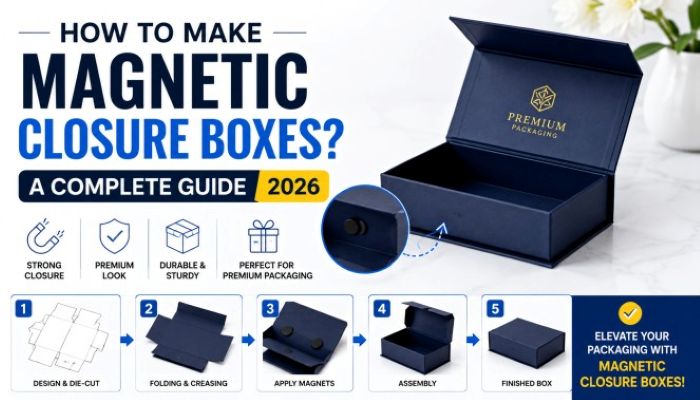
What does it feel like when you buy a high-quality smartphone, a luxurious fragrance, or a piece of jewelry and hear that magical snap as you lift the cover off the box? There is a reason why such packaging has that delightful sound of the box snapping shut. This is a special feature designed to convey your purchase of something very special.
That magic is achieved through the use of a specially designed magnetic closure box. More commonly referred to in packaging industry terms as a magnetic rigid box, a flip-top rigid box, this type of packaging utilizes magnets in order to seal itself shut.
Are you a business owner considering making your brand stand out with some luxurious packaging, or just someone who wants to know more about how luxurious packages are made? This article will explain everything there is to know about manufacturing magnetic closure boxes.
What Are These Magnetic Closure Boxes Made Of?
Before going into the box assembly process, let us take a look at the raw materials that will be needed to make the luxury magnetic gift box:
Greyboard (Or Chipboard): This is the thick and sturdy cardboard base. It does not bend easily and adds rigidity to the magnetic box, which resembles a brick. In making customized rigid boxes, the thickness for this material is between 1200 gsm and 2000 gsm (approximately 1.5 mm to 3 mm thick).
Neodymium Magnets: The powerful and rare-earth magnets are very useful in making these magnetic gift boxes. Though these magnets are as thin as a coin, they are very powerful in terms of pulling ability.
Wrapping Paper: This is used to cover up the industrial look of the greyboard material used. Coated art paper, eco-friendly textured kraft paper, and soft-touch paper are some of the varieties of wrapping papers used.
Step-by-Step: How Magnetic Closure Boxes Are Made
Building a magnetic closure box is no different from constructing a very accurate jigsaw puzzle. The process done by a professional packaging manufacturer is as follows:
Step 1: Designing the Blueprint (The Dieline)
This begins with a design on the computer. A structural designer measures the item and draws a flat, 2-dimensional blueprint using what is called the dieline template. Because greyboard is bulky when it comes to folding, a 2mm allowance must be made on each corner. Otherwise, there will be no proper alignment of the magnets.
Step 2: Printing and Customization
Before gluing the paper to the thick cardboard base, the paper is transformed visually through using high-end offset or digital printing, where the logos of the brand are applied using the CMYK or Pantone color matching systems.
To make sure that this paper looks like it belongs to ultra-premium luxury packaging, some customization options are used:
- Foil Stamping – Foil stamping gold, silver or rose gold foil on the logo.
- Embossing – Creating an effect of the raised logo or text that could be touched by your finger.
- Matte or Gloss Lamination – Protecting the box from scratches and moisture with a thin plastic coating.
Step 3: Cutting and V-Grooving the Board
These large panels are then placed in the die-cutter machine, which cuts out the outline of the box sides. The third step involves using another machine to cut “V” grooves on the board along the fold lines. This technique is called grooving, and it ensures that the stiff board can be folded into 90-degree angles without breaking.
Step 4: Embedding the Hidden Magnets
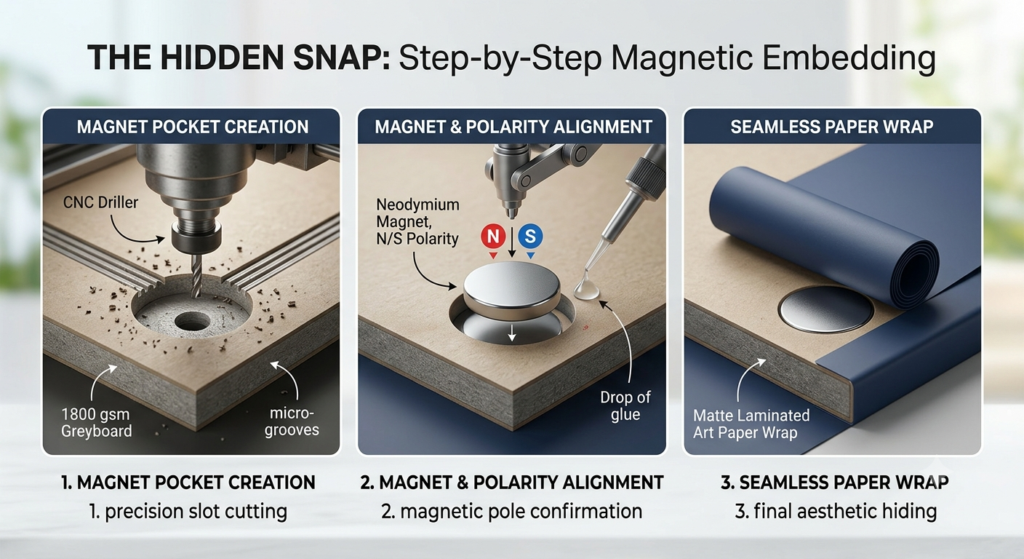
This is the key component that makes everything work. In order to maintain the perfect flatness of the surface, the machine punctures holes in the cardboard wall that are shallow and small.
Neodymium disc magnets are then glued inside those holes.
A Very Important Point: The constructors must pay extreme attention to magnetic pole orientations (both positive and negative). The wrong orientation will result in a lid pushing away from the box instead of snapping shut!
Step 5: Shaping the Box
The flat and grooved sheet is bent upward to form a 3-dimensional structure. A machine applies heavy-duty corner holding tape on all the edges of the bottom tray. You now have your firm and grey structure without any wrapping.
Step 6: The Final Wrap
Pre-printed wrapping paper is passed through a gluing machine. Robotic arms make sure that the grey 3-dimensional structure is placed accurately on the glued paper. The paper is then folded around the edges and tucked under, hiding the grey structure and covering the magnets.
Step 7: Adding Inserts and Quality Checks
To ensure that your product does not rattle within the package, an insert made from a special material is inserted. This can be either high-density EVA foam, pulp, or silk material. Lastly, your box is tested to ensure the “snap factor” functions perfectly.
Rigid vs. Foldable Magnetic Boxes: Which Do You Need?
Once you have decided to collaborate with a packaging company, the company will certainly ask you whether you require a rigid magnetic box or a collapsible one. The differences between the two kinds of boxes are described below:
- Rigid Magnetic Box: In these types of boxes, the entire box reaches you as fully assembled. They give you the most luxurious look, but at the same time, they occupy much space in the warehouse and increase the shipping costs because of their bulky nature.
- Foldable/Collapsible Magnetic Boxes: These kinds of boxes are designed to reach you in a completely flat form. There is also a presence of pre-applied adhesive tape on the corners of these boxes. Whenever you want to assemble these boxes, you need to remove the tape and pop these boxes into their rigid form.
| Feature | Rigid Magnetic Boxes | Foldable/Collapsible Magnetic Boxes |
| Structure | Shipped fully assembled and rigid. | Shipped flat with pre-applied adhesive strips. |
| Logistics | Higher shipping costs due to volumetric weight. | Logistics and operational efficiency; massive savings on freight. |
| Storage Space | Requires significant warehouse space. | Takes up minimal space; easily assembled on-demand. |
| Best For | Ultra-luxury retail, heavy items, high-end electronics. | E-commerce brands, cosmetics, subscription boxes. |
Tips to Design Custom Magnetic Closure Boxes
- Consider Board Thickness: Ensure that your art always goes onto a legitimate 3D dieline that is made available to you by your manufacturer. Logos and text must be kept at a minimum distance of 5mm from the folds to prevent warping.
- Select Magnet Size Based on Product Weight: A cosmetic box that does not weigh much needs only tiny magnets, while items like wine and electronics need larger magnets to hold the lids in place.
- Pick Your Paperboard Texture Carefully: Choose matte lamination for a contemporary appearance, gloss for colorful images on technology products, kraft texture for an organic look, and soft touch coating for an extremely luxurious feel.
- Go for Sustainability: The trend among consumers will be environmentally friendly packaging in 2026. Go with FSC-certified paperboard, soy ink, and make sure that your box looks good enough to be reused as a storage box.
Why Invest in Custom Magnetic Boxes in 2026?
As the market for e-commerce gets increasingly crowded, brown shipping boxes simply won’t do the trick.
- Increased Perceived Value: As soon as your customer opens the box that feels solid, heavy, and clicks shut, he knows he paid good money for a product worthy of that.
- Luxury Packaging and Environmental Protection Together: You no longer have to give up on luxury for sustainability in 2026. Modern producers can craft custom rigid boxes using paperboard with FSC certification and non-toxic, water-based glue.
- Free Marketing Forever: People love to keep the custom rigid boxes they receive. The beauty of your design compels them to reuse the box to store either makeup, jewelry, or important documents on their desk.
Ready to Upgrade Your Packaging?
In order to change the way your product is being presented, it is important to find a balance between advanced structural design and the best design solutions. In case you are ready to offer your customers the most elite unboxing experience that will keep your brand in their minds, cooperation with a dedicated specialist can be very helpful for you. Contact Custom Rigid Boxes right now to work with our experts in design, receive a free customized dieline template, and use premium structural textures.
FAQs
The regular box employs two magnets – one is mounted on the front side of the base, and another one inside the lid. Heavier boxes have four magnets at each corner to achieve reliable sealing.
Not at all. The tiny neodymium magnets are protected by chipboard and special wrapping paper. Thus, their influence remains local only and does not affect your smartphone, smartwatch, or any other gadget.
Rigid magnetic boxes are supplied completely assembled and provide the highest level of luxury feeling, but they take up a lot of space in storage. Foldable magnetic boxes come with pre-glued corners and are completely flat, thereby saving logistics efficiency.
The rigidity is provided by the dense cardboard called greyboard or chipboard which usually ranges from 1200 to 2000 gsm.
That may happen due to the mistake of the packaging producer who turns the north and south poles of the neodymium magnets around.
