 sales@customrigidboxes.com
 (631) 250-5009


Best Printing Methods for Custom Rigid Boxes
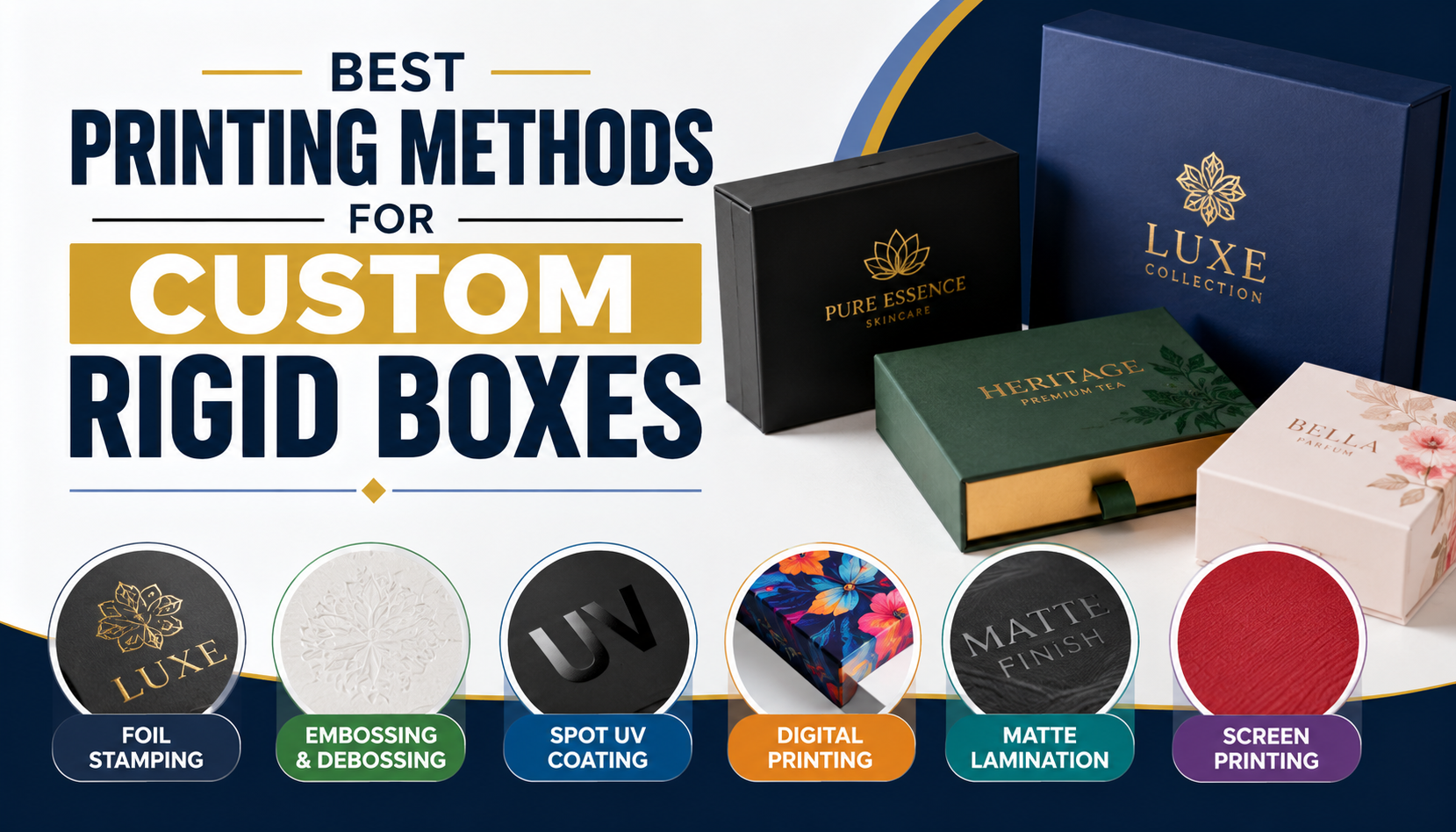
When you invest in custom rigid boxes, the printing method can make just as much difference as the box style itself. A well-designed box can communicate quality, reinforce your brand identity, and make your product look more valuable before the customer even opens it. But achieving that polished appearance depends on choosing the right rigid box printing technique for your artwork, material, order quantity, and desired finish.
From traditional offset printing to flexible digital printing and specialty techniques such as screen printing, there are several ways to decorate and personalise rigid packaging. The right choice depends on whether you need high-volume production, intricate artwork, short-run packaging, bold branding, or luxury embellishments.
In this guide, we’ll explore the best printing methods for custom rigid boxes, explain the advantages of each technique, and show you how to choose the right solution for your brand.
Why Printing Matters for Custom Rigid Boxes
Rigid boxes already have a premium reputation because of their sturdy construction, thick rigid board, and refined appearance. However, plain packaging does not necessarily communicate what makes your brand different.
Professional printing transforms a basic box into custom printed rigid packaging that carries your logo, colours, imagery, messaging, and visual identity.
For luxury products, packaging is often part of the overall product experience. This is why luxury rigid boxes, premium packaging boxes, and custom packaging boxes are commonly enhanced with high-quality printing and finishing techniques.
Your printing choices can help you:
- Display your brand logo and identity
- Reproduce detailed graphics and product imagery
- Maintain consistent brand colours
- Create premium-looking retail packaging
- Highlight important product information
- Build a memorable unboxing experience
- Combine printing with foil stamping, embossing, or spot UV
Rigid box printing is particularly versatile because the decorative outer wrap can be produced using different print technologies and then enhanced with specialist finishing processes.
What Are the Best Printing Methods for Rigid Boxes?
The most commonly used techniques for custom rigid box printing include offset printing, digital printing, and screen printing. Each has a different production workflow and is suited to different packaging requirements.
The most important factors to consider are order quantity, artwork complexity, colour requirements, turnaround time, and the overall look you want to achieve.
1. Offset Printing
Offset printing is one of the most established choices for high-quality packaging production. It is particularly suitable when a brand needs a consistent design across a larger quantity of printed rigid boxes.
With offset printing, the artwork is transferred through printing plates before being applied to the paper used for the box wrap. This production method is well suited to detailed artwork, strong colour reproduction, and repeat production where maintaining consistency from box to box is important. Packaging printers commonly combine offset and digital workflows according to run length and production requirements.
Why choose offset printing for rigid boxes?
Offset printing is a strong option for:
- Large-volume rigid box orders
- Luxury retail packaging
- Detailed graphics
- Brand-specific colour requirements
- Consistent repeat production
- High-resolution artwork
- Premium product packaging
If your company orders thousands of boxes with the same artwork, offset-printed rigid boxes can provide an efficient production solution.
It is especially useful for established brands that require the same packaging design across multiple production runs.
2. Digital Printing
Digital printing has become an increasingly useful solution for modern custom rigid packaging, particularly when brands require flexibility, short production runs, or frequent artwork changes.
Unlike traditional plate-based processes, digital printing sends the artwork electronically to the printing equipment. This reduces the need for conventional plate preparation and makes digital workflows particularly suitable for customised and variable packaging jobs. HP, for example, highlights digital printing’s flexibility for customised packaging and short-run applications, while Heidelberg describes digital production as particularly useful for short runs, reprints, and variable-data jobs.
Why choose digital printing for rigid boxes?
Digital printing works especially well for:
- Short-run rigid boxes
- Product launches
- Seasonal packaging
- Limited-edition collections
- Prototype packaging
- Personalised packaging
- Multiple box designs
- Campaign-specific packaging
- Small and growing businesses
For example, a cosmetics company launching a limited-edition skincare collection may not want to order a massive quantity of one design. Digital printed rigid boxes provide the flexibility to produce a smaller quantity while still achieving detailed full-colour artwork.
Digital printing can also be valuable when a brand expects its artwork to change regularly. Instead of committing to a single large production run, businesses can create updated packaging designs as campaigns, product lines, or promotions evolve.
3. Screen Printing
Screen printing is another option for rigid box printing, especially when the goal is to create bold graphics, strong colour coverage, or a distinctive tactile appearance.
In screen printing, ink is transferred through a mesh screen using a stencil. This allows relatively dense layers of ink to be applied to the selected surface.
Screen printing is particularly interesting for designs that do not rely heavily on photographic imagery but instead use logos, typography, simple graphics, or bold visual elements.
Why choose screen printing for rigid boxes?
It can be a good choice for:
- Minimalist packaging
- Bold logos
- Simple graphic designs
- Strong colour effects
- Premium branding details
- Specialty inks and effects
For example, a luxury candle company may choose a simple matte rigid box with a contrasting screen-printed logo rather than covering the entire package with complex artwork.
The result can be understated, refined, and highly intentional.
Offset vs Digital Printing for Custom Rigid Boxes
One of the most common questions brands ask is whether they should choose offset printing or digital printing.
There is no universal winner. The best option depends on your project.
| Factor | Offset Printing | Digital Printing |
| Best for | Larger production runs | Short and customised runs |
| Setup | Requires traditional setup/plates | Digital workflow |
| Artwork changes | Less convenient between runs | Easier to change |
| Personalisation | Limited compared with digital | Excellent for variable artwork |
| Large-volume production | Excellent | Suitable depending on the project |
| Short runs | Can be less efficient | Strong choice |
| Detailed graphics | Excellent | Excellent |
| Product launches | Suitable for larger quantities | Particularly flexible |
| Repeat designs | Excellent | Excellent |
The packaging industry increasingly uses both technologies rather than treating them as competing solutions. Heidelberg, for example, describes hybrid production environments where printers use digital and offset processes according to the job requirements and run length.
Which one is better for your business?
Choose offset printing when you have a substantial quantity and need consistent production of one design.
Choose digital printing when you need flexibility, short runs, fast design changes, or personalised packaging.
For larger packaging programmes, a qualified rigid box manufacturer can recommend the most efficient process based on your order volume, artwork, material, and finishing requirements.
Can Printing Be Combined With Other Rigid Box Finishes?
Absolutely. Printing is only one part of premium packaging design.
Many custom rigid boxes combine conventional printing with specialist finishing techniques to create additional contrast, texture, shine, or depth.
Some of the most popular combinations include:
Foil Stamping
Foil stamping adds a metallic or specialty foil effect to selected areas of the box. Gold, silver, copper, coloured, and other specialty foils can be used to highlight logos, typography, borders, and decorative details.
It is particularly popular for luxury rigid boxes, perfume packaging, jewellery boxes, premium gift packaging, and high-end cosmetics.
Embossing
Embossing raises selected elements above the surface to create a tactile three-dimensional effect.
A brand logo, pattern, lettering, or decorative motif can be embossed so customers can see and feel the design.
Debossing
Debossing produces the opposite effect by pressing the design into the material.
It is particularly effective for minimalist premium packaging boxes, especially when a brand wants a sophisticated result without excessive decoration.
Spot UV
Spot UV coating applies a glossy finish to selected areas of the packaging rather than covering the entire surface.
For example, you can print a rigid box with a soft matte finish and apply spot UV to your logo. The contrast between the two surfaces makes the branding more noticeable.
Packaging examples frequently combine spot UV, embossing, debossing, foil stamping, and other specialty effects to create contrast and visual depth.
Matte and Gloss Lamination
Lamination changes the visual and tactile character of the outer surface.
A matte finish creates a smooth, understated appearance, while a gloss finish can make colours and graphics appear more vibrant.
Soft-touch finishes can also be used when a brand wants a more tactile, velvety surface.
Choosing the Right Printing Method for Your Rigid Boxes
Before selecting a printing process, consider more than just the appearance.
Consider Your Order Quantity
Your production quantity is one of the first factors to discuss with your packaging supplier.
For high-volume orders with one consistent design, offset printing may make more sense.
For smaller runs, prototypes, or designs that change frequently, digital printing can provide greater flexibility.
Modern packaging operations often use different print technologies depending on run length and production needs rather than relying on one process for every job.
Consider Your Artwork
The complexity of your artwork also matters.
If your packaging contains:
- High-resolution photographs
- Gradients
- Intricate illustrations
- Fine typography
- Multiple colours
- Detailed patterns
You should work with a printer that can reproduce those elements accurately on the selected wrap material.
For simpler packaging, bold screen printing or a restrained print treatment may create a stronger visual result.
Consider Your Brand Identity
Your packaging should look like an extension of your brand.
A skincare company may prefer clean typography, muted colours, matte lamination, and subtle embossing.
A children’s brand may require bright colours, playful graphics, and detailed illustrations.
A luxury jewellery company may choose a dark rigid box with minimal branding, gold foil, and an embossed logo.
The best custom printed rigid boxes are not necessarily the ones with the most decoration. They are the ones where the printing and finishing support the brand message.
Consider the Box Material
Rigid boxes are commonly constructed from thick board with a printed or decorative wrap. The choice of covering paper, texture, colour, and finish influences how the final printing appears.
Dark, textured, metallic, and speciality papers can create different results than smooth white stocks.
This is why it is important to evaluate the printing method together with the box material rather than treating them as completely separate decisions.
How CMYK and Pantone Colours Work for Rigid Box Printing
Colour consistency is critical in branded packaging.
Two common colour systems used in commercial packaging are CMYK and Pantone.
CMYK printing uses cyan, magenta, yellow, and black to create a wide range of printed colours.
Pantone colours, often referred to as PMS colours, are frequently used when a brand needs a specific spot colour to be reproduced consistently.
For companies with a recognisable signature colour, discussing colour matching with your packaging manufacturer before production is especially important.
A professional printer can advise whether your artwork should be produced using CMYK, spot colours, or a combination, depending on the design.
Printing Methods for Different Types of Rigid Boxes
Different packaging styles can benefit from different printing approaches.
Magnetic Closure Boxes
Magnetic closure boxes are frequently used for premium products and gifting. Offset or digital printing can be combined with foil stamping, embossing, or spot UV for a sophisticated appearance.
Drawer Style Rigid Boxes
Drawer boxes often provide a large printable surface, making them suitable for detailed patterns, branding, product photography, or premium typography.
Book Style Rigid Boxes
Book-style rigid boxes can use printing across the outer cover, along with foil or embossing to create an appearance inspired by premium books or luxury cases.
Two-Piece Rigid Boxes
Two-piece rigid boxes provide separate lid and base sections and offer plenty of space for custom branding. They are widely used for gift packaging, apparel, jewellery, cosmetics, and other premium products.
Collapsible Rigid Boxes
Collapsible rigid boxes can combine sophisticated printing with space-saving construction. They are particularly useful for brands that want a luxury presentation while reducing the storage volume of empty packaging.
How to Get the Best Print Quality on Rigid Boxes
Even the best printing process cannot compensate for poor artwork preparation or unsuitable production specifications.
For the strongest final result:
Use High-Resolution Artwork
Always provide professional, print-ready artwork whenever possible. Vector files are particularly useful for logos and typography because they can be scaled without losing sharpness.
Create Proper Bleed
Design files should include the correct bleed and safe areas to prevent unwanted white edges or trimming issues.
Check Colour Requirements
Discuss CMYK and Pantone requirements with your packaging supplier before production, particularly when precise brand colours are important.
Request a Proof
A proof can help you review artwork placement, colours, logo positioning, and design details before full production.
Consider the Final Finish
Remember that lamination, foil, embossing, debossing, and UV finishes can change how colours and surfaces look.
Your final packaging should be evaluated as a complete system rather than as printing alone.
Common Mistakes to Avoid When Printing Rigid Boxes
Choosing a printing method purely because it is popular can lead to unnecessary expense or a result that does not match your brand.
- Avoid choosing a process without considering the quantity you actually need.
- Avoid using low-resolution artwork for premium custom packaging boxes.
- Avoid selecting colours without checking how they will reproduce on your chosen material.
- Avoid adding too many finishes simply because they are available.
And most importantly, do not treat packaging printing as an afterthought.
The strongest rigid packaging boxes are planned from the beginning around the product, box structure, branding, print method, finishing, and customer experience.
Which Printing Method Is Best for Custom Rigid Boxes?
For most brands, the answer comes down to the project’s specific requirements.
Offset printing is an excellent choice for larger-volume production, detailed artwork, and repeat packaging programmes where consistent results matter.
Digital printing is ideal when flexibility is important, particularly for shorter runs, product launches, seasonal packaging, prototypes, or personalised designs. Digital printing is increasingly positioned for customised packaging applications because artwork can be changed without the traditional plate workflow associated with conventional printing.
Screen printing works well for bold logos, simpler graphics, and specialty visual effects where a distinctive ink application is part of the desired appearance.
And for luxury presentation, the printing method can be combined with foil stamping, embossing, debossing, spot UV, and premium lamination to create packaging that looks and feels significantly more distinctive.
Final Thoughts
At Custom Rigid Boxes, the goal is not simply to put a logo on a box. The right approach is to build custom rigid packaging where structure, printing, materials, and finishing work together to present your product professionally.
Whether you’re developing luxury rigid boxes, custom printed rigid boxes, rigid gift boxes, magnetic closure boxes, or bespoke retail packaging, choosing the right printing technique at the start can make a significant difference to the final result.
Ready to create packaging that looks as premium as the product inside? Explore custom rigid boxes with professional printing, tailored dimensions, premium finishes, and brand-focused design options from Custom Rigid Boxes.
